

Sometimes the conditions change before we do.
A career changes.
A relationship changes.
Success changes us.
Our responsibilities change.
Our capacity changes.
Something we wanted arrives.
Something we counted on disappears.
Or nothing particularly dramatic happens at all.
We simply begin noticing that a way of living that once made perfect sense doesn't fit quite the same way anymore.
That's where Identity-Level Recalibration begins.
Not with the assumption that something is wrong with you.
With Recognition.
The conditions have changed. Who are you now?
We build identities in relationship with our lives.
We learn what works.
What keeps us safe.
What earns belonging.
What helps us succeed.
What other people need from us.
What we're good at.
What we're responsible for.
What gets rewarded.
And over time, some of those ways of being become so familiar that they stop feeling like choices.
They simply feel like who I am.
But conditions change.
And an identity can remain long after some of the conditions that shaped it no longer exist.
That's when you may find yourself working harder at something that used to work.
Repeating a strategy that no longer produces the same result.
Feeling strangely disconnected from a life you genuinely chose.
Wanting something different without knowing exactly what.

Or recognizing that you're still capable of doing what you've always done—
you just aren't sure you want to keep doing it the same way.
That doesn't necessarily mean the old way was wrong.
It may mean something has changed.
And you noticed.
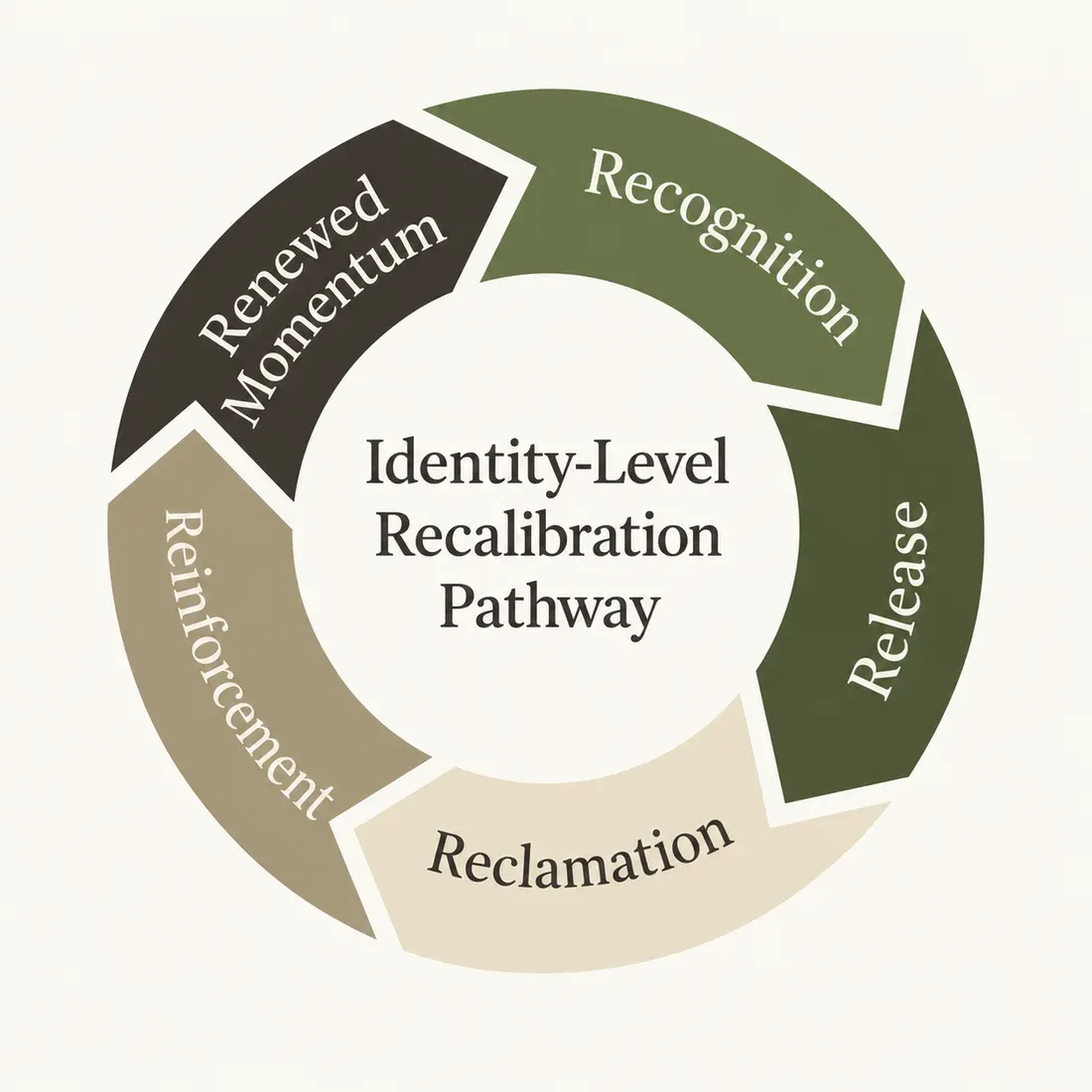
Identity-Level Recalibration is a pathway.
The pathway has five stages:
Recognition
Noticing what's here.
Release
Discerning what no longer needs to be carried in the same way.
Reclamation
Recovering, claiming or bringing forward what belongs.
Reinforcement
Practicing and gathering lived evidence for a different way of being.
Renewed Momentum
Moving again from a place that is more integrated with who you are now.
But there's something important about those five stages:
The pathway has five stages. It isn't a five-step process.
You don't graduate from Recognition and never recognize anything again.
You may begin releasing something and discover there's another layer to recognize.
Release and Reclamation may happen together.
You may be reinforcing something new when an old pattern returns.
Renewed Momentum may reveal something that brings you right back into Recognition.
You can move forward.
Circle back.
Pause.
Experience more than one stage at once.
Because this isn't a formula for successfully transforming yourself.
The pathway has shape without requiring your life to follow a formula.
It gives us a way to recognize what may be happening.
Then we get curious about it.
Recognition
You can't choose what you haven't noticed.
Recognition is awareness.
But not the kind that immediately asks:
How do I fix this?
We stay here a little longer.
What is actually happening?
What am I doing?
What am I believing?
What role am I playing?
What am I protecting?
What does this make possible?
And what does maintaining it require from me?
Sometimes Recognition begins with friction.
Sometimes exhaustion.
Resentment.
Restlessness.
A recurring conflict.
A desire you keep dismissing.
An open calendar you immediately fill.
A decision you can't seem to make.
Sometimes it begins because something is going wonderfully and you suddenly realize:
I don't want to experience this the way I would have five years ago.
Recognition isn't an indictment.
It's information.
We notice so you can choose.
Release
Release isn't rejection.
This distinction matters.
We're not looking backward so we can decide everything was secretly unhealthy.
We're not taking an identity you once needed, benefited from or genuinely loved and declaring it false.
And we're not stripping away everything life has taught you in pursuit of some untouched “real self.”
Instead, we ask:
Does this still belong in the same role in my life now?
Maybe responsibility has been one of your greatest strengths.
But somewhere along the way, being responsible became being responsible for everything.
Maybe achievement opened doors, created freedom and gave you experiences you genuinely value.
But proving became tangled up in the achieving.
Maybe protecting yourself was once necessary.
Maybe the protector became perceptive, discerning and exceptionally good at reading a room.
We don't have to destroy the protector to change its job.
Release can mean loosening.
Repositioning.
Setting something down.
Allowing an old strategy to stop running the whole system.
You can honor what something did for you without requiring it to keep doing the same job forever.
Reclamation
Release creates room.
Then another question becomes possible:
What belongs here now?
Sometimes Recalibration isn't about becoming someone new.
It's reclamation.
A part of you that became quiet.
Playfulness.
Creativity.
Courage.
Rest.
Ambition.
Trust.
Curiosity.
Desire.
A way of being that existed before life became organized around responsibility, performance, survival, expectation or simply the demands of a particular season.
But Reclamation isn't regression.
We're not trying to recreate an earlier version of you.
We ask:
What remains true?
What have I lost touch with?
What has life genuinely added to me?
And:
What do I want to bring forward now?
You don't go backward to become who you were.
You bring what still belongs forward into who you're becoming.
Reinforcement
Understanding something is not the same as living it.
You can have an extraordinary insight on Tuesday and find yourself doing exactly what you've always done by Friday.
That doesn't make the insight false.
And it doesn't mean you failed.
The old pattern returning can be a gift.
Now you can see it.
You have contrast.
You know what the automatic response feels like—and perhaps, for the first time, you know what another response feels like too.
Reinforcement is where insight begins gathering lived evidence.
You make the different choice.
Rest when you would have pushed.
Speak when you would have stayed quiet.
Wait when you would have rushed.
Ask for help.
Leave the space open.
Take the risk.
Try again.
And each experience gives you information.
Not:
Did I do Recalibration correctly?
But:
What did I notice?
What happened when I chose differently?
What do I want to practice again?
Identity isn't reinforced only through what you understand.
It's reinforced through what you experience yourself doing.
Renewed Momentum
Eventually, movement begins to return.
But the goal isn't to manufacture momentum as quickly as possible.
Renewed Momentum is what can emerge when you're no longer spending quite so much energy maintaining something that doesn't belong in the same way anymore.
You may move toward the same goal differently.
Choose a different goal.
Return to something you'd abandoned.
Make a decision.
Create.
Lead.
Rest.
Build.
Begin again.
The movement itself isn't what makes the Recalibration successful.
What matters is what's driving it.
Because momentum can also recreate the exact conditions that made Recalibration necessary.
That's why Renewed Momentum isn't graduation.
It isn't the end of the pathway.
It's another place to notice.
Another opportunity to choose.
And sometimes—
another Recognition.
Not everything acquired needs to be stripped away.
This is one of the most important distinctions in Identity-Level Recalibration.
Not every adaptation is a wound.
Not every difficult experience created something that needs to be undone.
Life adds things to us.
Experience develops capacity.
Difficulty can develop discernment.
Responsibility can develop leadership.
Success can develop confidence.
Loss can change what matters.
Relationships can expand us.
Age can soften something that once needed to be rigid.
We aren't trying to excavate your life until we locate some pristine version of you that existed before the world got involved.
We're asking more interesting questions:
What remains true?
What has completed its work?
What have I lost touch with?
What has life genuinely added to me?
That is a very different kind of Recalibration.
And sometimes the evidence is small.
Someone I've worked with spent years being the provider and protector.
When we began looking at that identity, the goal wasn't to get rid of the protector.
That part of him had developed extraordinary capacity.
But protecting everyone had also become exhausting.
One of the earliest pieces of evidence that something was changing wasn't dramatic.
He took a nap.
Another person began noticing how quickly she filled every open space in her business.
She had intentionally created room—and then immediately began finding ways to make herself productive again.
Once she saw the pattern, she said:
“I can't unsee this.”
Someone else, entering a new season of life, began reclaiming something she hadn't realized she'd lost:
Her playfulness.
None of these moments would make particularly impressive before-and-after photographs.
But that's often what Recalibration looks like.
Small moments can tell you something much larger has changed.
Identity-Level Recalibration isn't therapy.
Identity-Level Recalibration is identity-level pattern work.
It is not therapy and does not treat mental illness.
Therapy and clinical care can be important, valuable and appropriate.
Recalibration has a different purpose.
We work with the identities, patterns, choices and ways of being that are shaping how you experience your life now—and what you want to practice moving forward.
The question isn't:
What's wrong with me?
It's closer to:
What's shaping how I'm living?
Does it still belong?
And what do I want to practice instead?
There is no finish line.
You don't complete Identity-Level Recalibration and become permanently calibrated.
Life keeps changing.
So do you.
The conditions that fit today may not fit five years from now.
A new relationship can reveal something.
So can success.
Parenthood.
Leadership.
Loss.
Opportunity.
Age.
A dream coming true.
A dream changing.
The goal isn't to build an identity rigid enough to survive every possible future.
It's to become more practiced at noticing when something has changed—and more able to remain in relationship with yourself when it does.
Integration doesn't mean you never leave yourself.
It means you recognize it sooner—and you know the way back.
That's why Identity-Level Recalibration isn't something you finish.
It's a way of staying in relationship with your life.
Something brought you here.
Maybe something in this page gave language to something you've been noticing.
You don't need to turn that recognition into a decision yet.
You don't have to know which stage you're in.
And you don't need to figure out what comes next.
Start with what's here.
Get curious about it.
Get CuriousOr, if you're curious about practicing Identity-Level Recalibration with me and other people:
Explore Ways to Work With Julie